
Blog
Workshop Air Tools Complete Guide UK 2026: Engineering Efficiency, Compliance, and Professional Performance
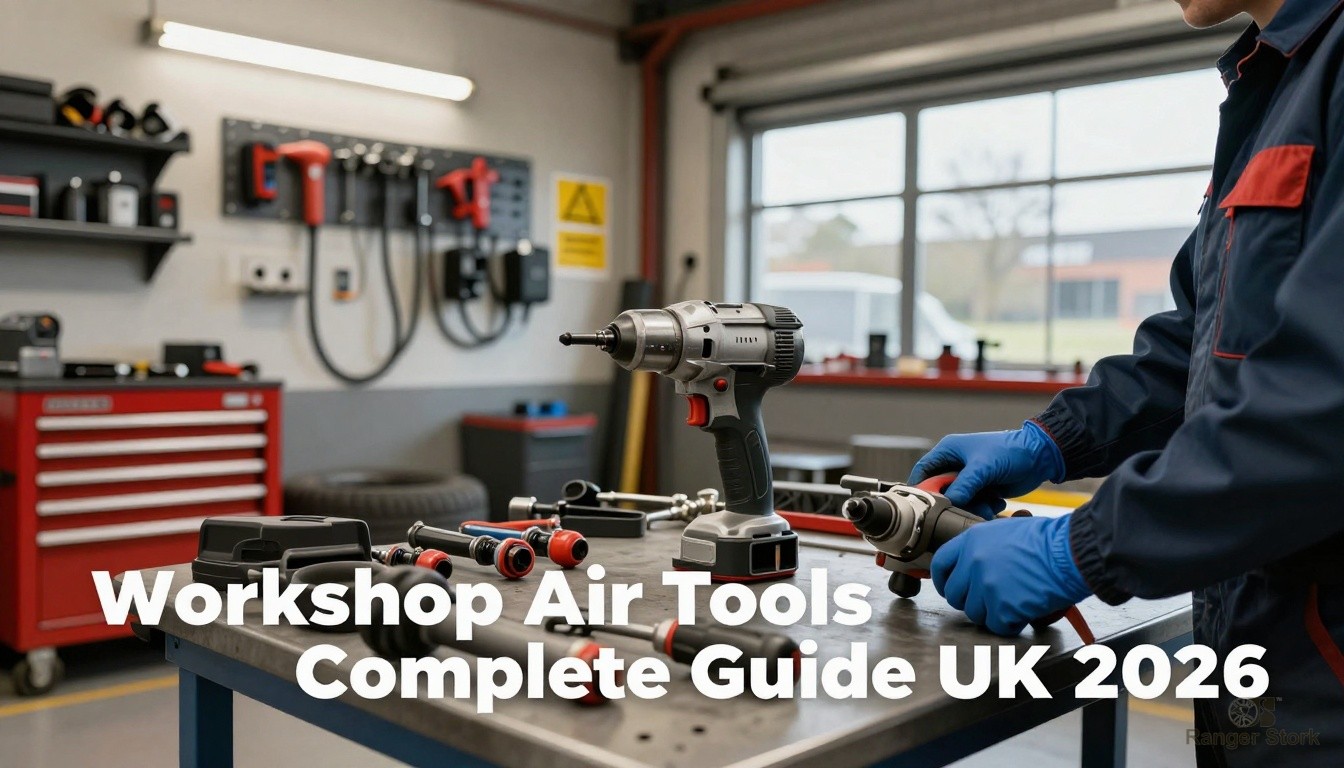
The Resurgence of Pneumatic Power in the 2026 UK Workshop
As we navigate the landscape of the 2026 UK automotive and industrial sectors, a profound realization has dawned upon workshop managers and procurement officers: while the “cordless revolution” promised a tether-free future, the rhythmic pulse of the air compressor remains the heartbeat of the truly productive professional environment. In high-duty cycle environments—where the demand for torque is relentless and the clock is the primary adversary—pneumatic tools have not merely survived; they have undergone a sophisticated evolution.
The current state of the UK workshop is defined by a strategic return to air. While cordless electric alternatives have made significant strides in portability, they often stumble when faced with the “duty cycle” requirements of a busy MOT centre or a heavy-duty commercial vehicle repair bay. A pneumatic tool does not suffer from battery degradation, nor does it require the technician to manage a dozen different charging cradles. Instead, it offers a consistent, stall-proof delivery of power that remains unmatched in power-to-weight ratios.
The evolution of air tool ergonomics leading into 2026 has focused on the “human-machine interface.” Modern tools are lighter, utilizing composite materials that reduce strain without sacrificing structural integrity. Simultaneously, the industry has seen a shift toward high-efficiency, energy-saving compressors. In an era of fluctuating UK energy prices, the synergy between a high-efficiency screw compressor and a well-maintained pneumatic line is a cornerstone of operational profitability.
This guide serves as a comprehensive roadmap for the modern workshop. We will journey from the “heart” of the system—the compressor—through the “veins” of the airline fittings, and finally to the “hands”—the tools that translate pressure into progress. For the B2B procurement officer or the workshop manager navigating the £50 to £500 price bracket, this is the definitive blueprint for pneumatic excellence.
Why UK Workshops Prioritize Pneumatic Tools Over Cordless Electric in 2026
While cordless tools have made massive strides, pneumatic tools remain the backbone of the professional UK workshop for three primary reasons: power-to-weight ratio, durability, and duty cycle. A pneumatic impact wrench is significantly lighter than its battery-powered counterpart because it doesn’t carry a heavy motor and lithium-ion cells. This is crucial for preventing technician fatigue and repetitive strain injuries (RSI).
Furthermore, air tools are “stall-proof” and can be used in damp or flammable environments where electric sparks pose a risk. In terms of longevity, a well-oiled air tool can last decades, whereas batteries degrade over 3–5 years and represent a significant recurring cost. For high-volume B2B environments like tyre bays or production lines, the unlimited “runtime” of a compressor-linked tool outweighs the convenience of cordless mobility.
Heavy Hitters: Pneumatic Impact Wrenches and Air Ratchets
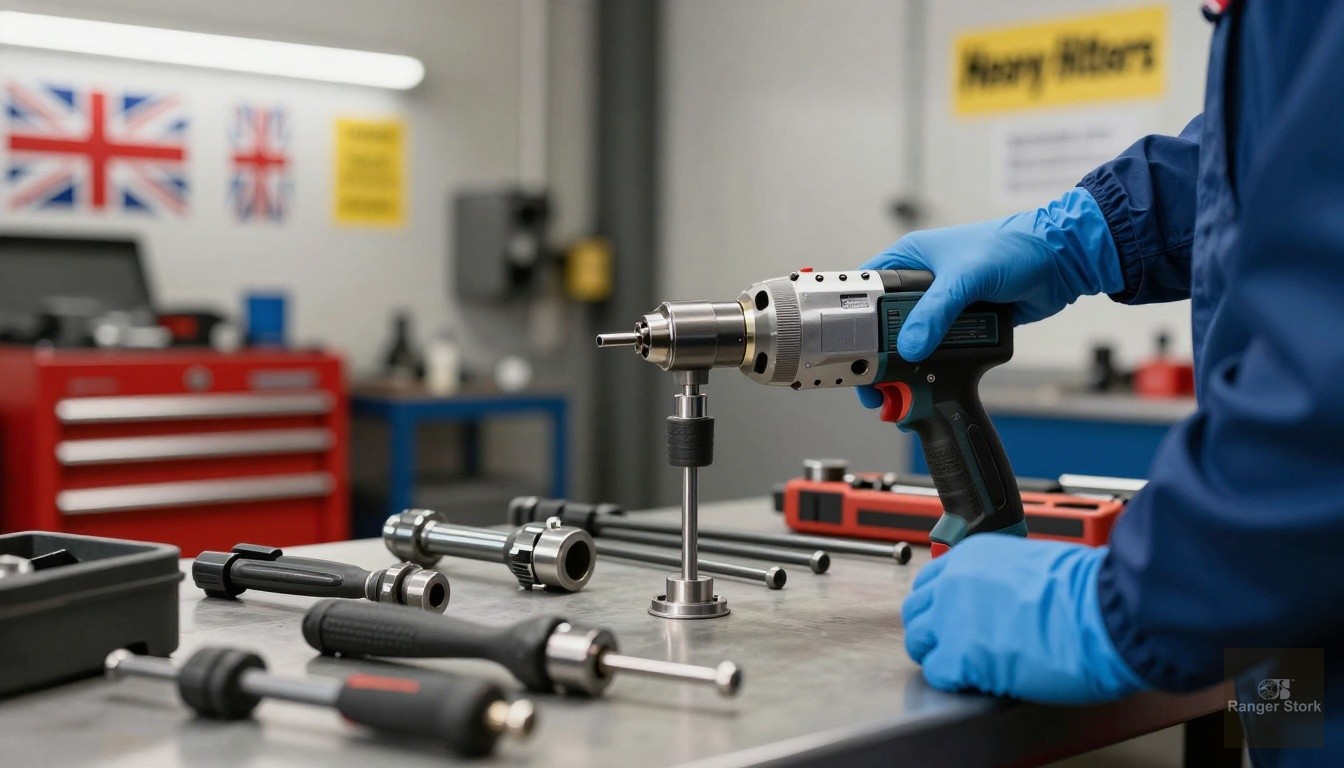
In the theatre of the modern workshop, the impact wrench is the protagonist. By 2026, the standards for 1/2” and 3/4” impact wrenches have shifted toward the “Twin-Hammer” mechanism as the industry benchmark. This design provides a balanced, instantaneous delivery of power, allowing tools to achieve breakaway torque ratings exceeding 1,500Nm. For UK commercial vehicle work, where rusted chassis bolts and over-torqued wheel nuts are daily obstacles, this level of force is non-negotiable.
The Evolution of 1/2” and 3/4” Standards
The 1/2” impact wrench remains the workhorse of the automotive sector, but the 2026 models have refined the power-to-weight ratio to an art form. A professional-grade wrench in the £150–£300 range now offers the same torque that required a heavy 3/4” tool a decade ago. This reduction in weight is not merely a matter of comfort; it is a strategic tool for mitigating Hand-Arm Vibration Syndrome (HAVS) and general fatigue during an eight-hour shift.
Parallel to the impact wrench is the air ratchet, a tool often underestimated but indispensable in the tight confines of modern engine bays. As vehicle manufacturers pack more components into smaller spaces, the bulk of a battery-powered ratchet becomes a hindrance. The latest “sealed head” pneumatic designs prevent internal contamination from grease and grit, ensuring a lifespan that far outlasts electric alternatives. These ratchets provide the finesse required for delicate assembly work while maintaining the “stall-proof” nature that allows a technician to use the tool as a manual breaker bar when necessary.
Investment Logic and B2B Pricing
When considering B2B pricing, the investment logic is clear. A £150–£300 investment in a professional-grade pneumatic wrench typically yields a five-year operational lifespan in a high-intensity environment. In contrast, cheaper DIY alternatives or even high-end cordless units often require replacement or expensive battery refreshes within half that time. For a workshop manager, the total cost of ownership (TCO) for pneumatic tools remains the most attractive fiscal option.
Precision and Utility: Tyre Inflators and Specialized Air Tools
Precision is the hallmark of a professional UK workshop, particularly concerning tyre inflation. The legal landscape in 2026 demands absolute accuracy, as tyre pressure is a critical factor in vehicle safety and MOT compliance. Using calibrated, BS EN 12645:2014 compliant gauges is not just a best practice; it is a necessity for any workshop looking to maintain its professional standing and legal protection.
The Role of “Smart” Digital Inflators
The rise of “smart” digital tyre inflators has revolutionized the throughput of busy MOT centres. These units, typically falling in the £80–£180 range, offer automated shut-off features. A technician can set the desired pressure, trigger the inflation, and attend to other tasks, knowing the unit will stop precisely at the target. This eliminates the “guesswork” and the constant checking associated with traditional analogue gauges, significantly increasing workshop efficiency.
Beyond inflation, the utility of air extends to surface preparation and cleanliness. High-flow blowguns and specialized cleaning tools are essential for preparing surfaces for painting, assembly, or inspection. In the UK’s damp climate, the ability to rapidly dry and clear debris from intricate components is a major advantage of a robust pneumatic system. Specialized tools, such as air-powered reciprocating saws and nibblers, provide a level of control and power in metalwork that electric tools struggle to replicate without significant bulk.
Standards for Professional Tyre Inflators
For a UK workshop, a tyre inflator is not just a tool but a piece of safety-critical equipment. In 2026, you should look for units that are “EC Directive” compliant and meet the BS EN 12645:2014 standard. This ensures the gauge is accurate to within narrow tolerances across its pressure range.
For B2B environments, durability is key; look for die-cast aluminium bodies and ceramic sensors in digital models. A “dual-stage” trigger—where the first position checks pressure and the second inflates—is preferred for precision. Given the UK’s focus on MOT compliance, choosing an inflator that comes with a calibration certificate is highly recommended. This provides a paper trail for quality audits and ensures that every vehicle leaving the workshop has correctly pressurized tyres for safety and fuel efficiency.
The Backbone of the System: PCL Connectors and Airline Fittings
If the compressor is the heart and the tools are the hands, the airline fittings are the veins of the workshop. In the UK, the “PCL” (Pneumatic Components Ltd) standard has long been the gold standard, but the landscape in 2026 requires a more nuanced understanding of connector profiles. The three primary profiles encountered are PCL “Standard,” PCL “Vertex,” and “XF-Euro.”
PCL Standard vs. Euro (XF)
Cross-compatibility issues and the use of mismatched fittings are the leading causes of air leaks in UK workshops. An air leak is not just a nuisance; it is a silent thief of profitability. Technical specifications from PCL indicate that their “Standard” coupling has a flow rate of approximately 42 CFM at 100 PSI. In contrast, their “XF-Euro” high-flow coupling offers up to 74 CFM—a 76% increase in flow.
Using a standard fitting on a high-flow tool is like trying to run a fire hose through a straw; the tool will never reach its rated torque, leading to frustration and lost time. For modern high-torque tools that require bursts of high-volume air, the Euro standard is the difference between a bolt coming loose in two seconds versus ten.
Safety and Maintenance: The FRL Unit
Safety is another critical factor in fitting selection. The HSE recommends the use of “anti-hose whip” safety couplings. These connectors require a two-stage disconnection process that bleeds the downstream air before the hose is released. This prevents the dangerous “whip” effect that can occur when a pressurized hose is suddenly disconnected, protecting both the technician and the surrounding vehicles.
The installation of a Filter-Regulator-Lubricator (FRL) unit is the single best investment for tool longevity. Compressed air is naturally “dirty”—it contains water vapour, rust from the tank, and degraded oil. An FRL unit removes these contaminants, regulates the pressure to the tool’s optimal 90 PSI (6.2 bar), and adds a fine mist of oil to lubricate internal components. Without an FRL, even a £500 impact wrench will suffer premature wear and failure.
The High Cost of Air Leaks
According to the Carbon Trust (UK), a single 3mm hole in a compressed air system can cost a business over £700 per year in wasted electricity (based on 2024/2026 UK energy prices). This highlights why B2B buyers should invest in high-quality PCL or Euro connectors and PTFE-sealed fittings. Regular “ultrasonic leak detection” or even simple soapy water tests are essential maintenance protocols that offer an immediate return on investment by reducing compressor run-time.
Engineering the Flow: CFM Requirements and Compressor Sizing
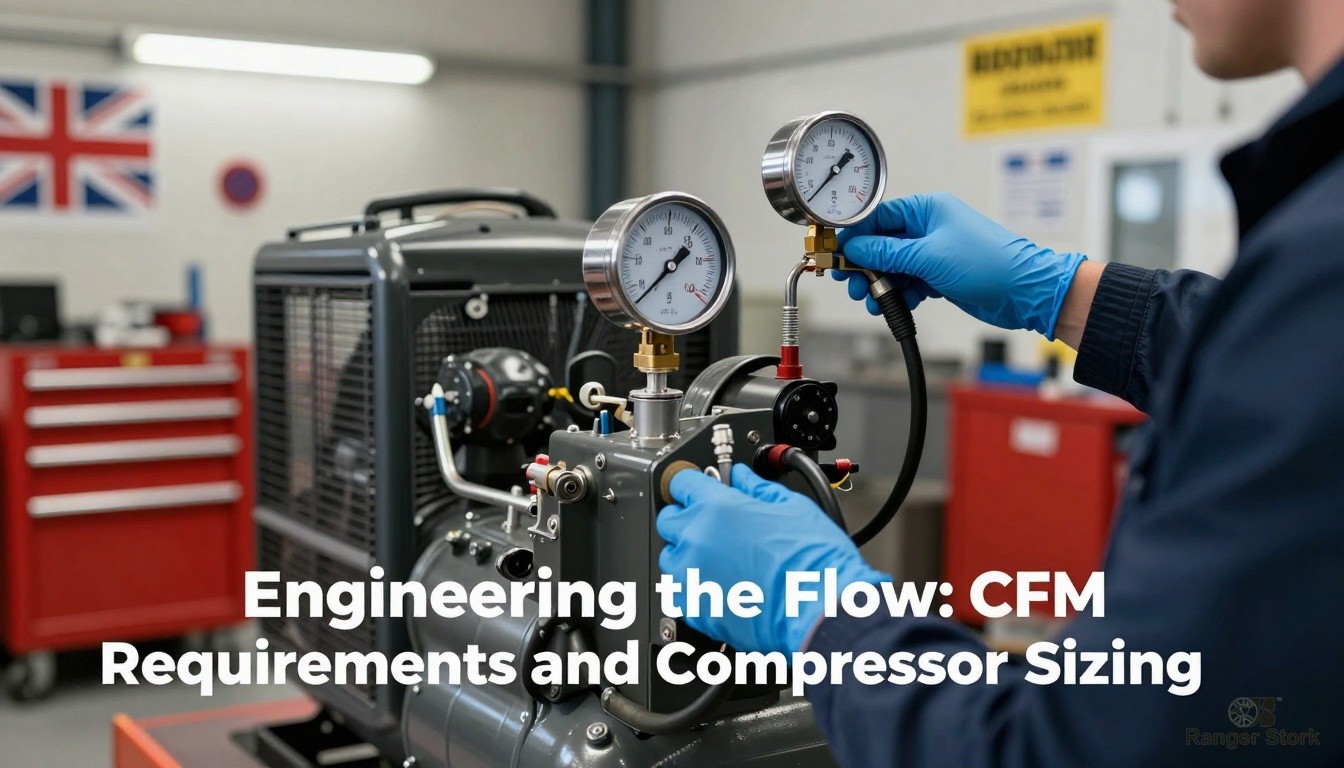
Sizing a compressor is the most common area of failure in workshop design. The most critical distinction to understand is between “Piston Displacement” and “Free Air Delivery” (FAD). Displacement is a theoretical calculation of the air the cylinders can move, while FAD is the actual amount of usable air delivered at the tool’s operating pressure. In the UK market, displacement is often used as a marketing figure, but FAD is the only number that matters for performance.
Calculating Workshop Demand
To accurately size a system, one must calculate the cumulative CFM (Cubic Feet per Minute) requirements of the tools intended for simultaneous use. The “1.5x rule” is a reliable benchmark: take the CFM requirements of your intermittent tools (like impact wrenches) and apply a 25% usage factor, then add the 100% CFM requirement of continuous tools (like sanders). Your compressor’s FAD should be 1.2 to 1.5 times this total.
CFM Requirements for Common Tools (at 90 PSI / 6.2 bar):
* 1/2” Impact Wrench (Intermittent): 4–6 CFM
* 3/8” Air Ratchet: 3–4 CFM
* Dual Action (DA) Sander (Continuous): 10–15 CFM
* Tyre Inflator: 1–2 CFM
* Air Nibbler/Saw: 8–12 CFM
If a workshop plans to run a DA sander and an impact wrench simultaneously, they require a compressor with a Free Air Delivery (FAD) of at least 20 CFM to avoid pressure drops that compromise performance.
Screw vs. Piston Compressors
In 2026, the shift toward “Screw” compressors for larger UK workshops has accelerated. While traditional “Piston” compressors are excellent for intermittent use and smaller B2B operations within the £500 entry-level commercial range, they are noisy and have limited duty cycles. Screw compressors offer continuous air delivery, significantly lower noise levels, and better energy efficiency.
Receiver tank sizing (measured in litres) also plays a vital role. A larger tank acts as a reservoir, allowing the compressor motor to rest while the tools draw from the stored air. In a high-inflation UK energy market, reducing the frequency of motor “start-stop” cycles is essential for minimizing electricity costs and extending the life of the compressor’s switchgear.
Compliance and Safety: HSE Noise and Vibration Regulations
Operating a pneumatic workshop in the UK carries significant legal responsibilities. Creating a “Safety First” culture involves more than just compliance; it involves proactive maintenance and intelligent procurement.
Noise Level Thresholds
The “Control of Noise at Work Regulations 2005” sets the Lower Exposure Action Value at 80 decibels (dB). Most standard pneumatic impact wrenches operate at 95–105 dB. This means that without mitigation, any use of these tools triggers the legal requirement for employers to provide hearing protection and training. B2B procurement of “Quiet Series” tools, which utilize internal mufflers to drop noise levels to 82–85 dB, significantly simplifies HSE compliance.
Hand-Arm Vibration Syndrome (HAVS)
HAVS is an area of intense HSE scrutiny. Prolonged exposure to vibration can cause permanent damage to nerves and blood vessels. UK law requires employers to monitor “trigger time”—the actual time the tool is vibrating in the technician’s hand.
A typical high-performance impact wrench may have a vibration emission level of 10–15 m/s². Under UK law, an employee’s “Exposure Action Value” (EAV) is 2.5 m/s² A(8). For many high-power tools, the safe “trigger time” per day may be as low as 15–30 minutes before control measures must be implemented. Choosing premium tools in the £300+ bracket often provides advanced vibration-dampening handles, which significantly extends the legal and safe working time.
Pressure Systems Safety Regulations 2000 (PSSR)
UK workshops must comply with the PSSR, which mandates that any pressure system containing a “relevant fluid” (including compressed air) at a pressure greater than 0.5 bar must have a “Written Scheme of Examination” (WSE). This involves regular inspections by a competent person to ensure the air receiver has not been weakened by internal corrosion. Failure to maintain a WSE can invalidate business insurance and lead to severe HSE penalties.
The Ritual of Preservation: Maintenance for Longevity
A pneumatic system is only as reliable as its maintenance schedule. In the UK, where humidity can lead to significant moisture buildup in air lines, a proactive approach is required to protect your B2B investment.
Moisture Management
Compressed air generates heat; as that air cools in the tank and lines, water precipitates. If this water reaches your tools, it washes away essential lubricants and causes internal corrosion.
* Daily: Drain the compressor tank using the purge valve.
* Monthly: Check and clean the filters in your FRL units.
* Annually: Inspect the entire pipework for “dead legs” where water might collect.
Lubrication Protocols
While some modern tools claim to be “lube-free,” the reality of a high-intensity workshop usually demands supplemental lubrication. An FRL unit should be set to deliver approximately one drop of oil for every 10–15 CFM of air. Using the correct grade of ISO VG 22 or 32 pneumatic oil is critical; using standard motor oil will gum up the internal vanes and destroy the tool.
Leak Audits
As previously mentioned, air leaks are an expensive drain on resources. A professional workshop should conduct a “leak walk” once a quarter. Using an ultrasonic leak detector can identify high-frequency sounds of escaping air even in a noisy environment. Replacing a £5 PCL coupling or a £2 O-ring can save hundreds of pounds in electricity over the following year.
B2B Procurement Strategy: Maximizing ROI between £50 and £500
Navigating the procurement of air tools requires a balanced approach to the “Tiered Purchasing Matrix.” Not every component of the system requires a premium investment, but “cheaping out” on the wrong items can lead to systemic failure.
The £50 – £150 Tier: Infrastructure and Utility
In this bracket, your focus should be on high-quality airline fittings (PCL or Euro/XF) and a robust Filter-Regulator-Lubricator (FRL) unit. A £50 FRL unit is the guardian of your entire tool collection; it is far better to spend £50 on protection than to watch a £400 tool succumb to water damage. Blowguns, high-quality air hoses (choose rubber or hybrid over PVC for flexibility), and basic tyre inflators also fall into this category.
The £150 – £300 Tier: The “Hero” Tools
This is where you should invest in your primary instruments—the 1/2” impact wrench or the high-precision digital tyre inflator. This is the sweet spot for professional UK workshops, where you find the best balance of power, vibration damping, and longevity. Tools in this range typically come with better warranty support and readily available spare parts from UK distributors.
The £300 – £500 Tier: Specialized and Heavy Duty
As you approach the £500 ceiling, you are looking at specialized equipment: high-end 3/4” impact wrenches for heavy plant work, or entry-level commercial-grade piston compressors. When spending at this level, “Total Cost of Ownership” (TCO) becomes the vital metric. Factor in repairability, the availability of service kits, and the energy efficiency of the unit.
Strategic Allocation Summary
Do not compromise on the infrastructure. Spend a larger portion of your budget on high-quality airline fittings and a decent FRL unit. For the tools themselves, prioritize your “hero” tool. If you are a mechanical shop, spend £250 on a premium brand 1/2” impact wrench with high vibration damping. Buy mid-range for tools used less frequently, like air ratchets or blowguns (£50–£100). By investing in the “veins” of the system first, you ensure that even mid-priced tools perform at their peak and you avoid the hidden costs of air leaks.
Conclusion: The Blueprint for Pneumatic Excellence
The 2026 UK workshop thrives on the synergy of tradition and technology. By understanding the nuances of CFM, the legalities of HSE compliance, and the strategic importance of high-flow connectors, the professional technician and the B2B buyer can build a pneumatic system that is efficient, safe, and built to last.
A well-designed pneumatic system is not a temporary fix; it is a 10-year investment. While the air may be invisible, the power it provides remains the very foundation of British industrial excellence. By prioritizing the quality of your infrastructure—from the PCL XF connectors to the calibrated tyre inflators—and the ergonomics of your “hero” tools, you ensure a workshop that is not only productive but also compliant with the highest standards of safety and efficiency. In the relentless pursuit of workshop perfection, air remains the undisputed champion of the professional realm.